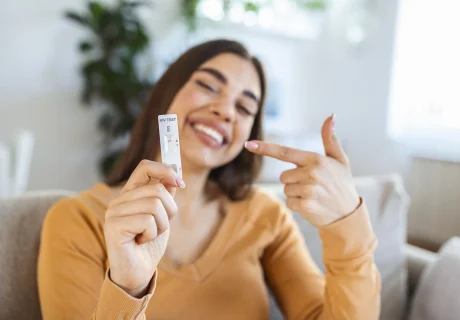

Different HIV testing options for different needs
HIV testing is available in different settings. Depending on the test, you may be able to test yourself at home or choose testing through a clinic, community testing service or laboratory.
Both options can play an important role in HIV testing, but they are not identical. The most suitable option depends on the type of test, the time since a possible exposure, the sample required and whether you would prefer professional support during the testing process.
The World Health Organization (WHO) recommends HIV self-testing as an additional approach to HIV testing services. A reactive self-test result does not by itself confirm an HIV diagnosis and requires follow-up testing by a trained provider.
| Aspect | HIV Self-Testing | Healthcare or Clinic Testing |
| Where you test | At home or another private location | Clinic, community testing service or laboratory |
| Sample | Depends on the specific product; for example, oral fluid or finger-prick blood | Depends on the test; may include finger-prick blood or blood taken from a vein |
| Result time | Usually rapid; always follow the Instructions for Use for the specific test | May be rapid or may take several days when a laboratory test is used |
| Window period | Depends on the type of test and sample used | Depends on the type of test and sample used; some laboratory tests can detect HIV earlier than antibody-only self-tests |
| Privacy | Testing can be performed privately at a place of your choice | Testing is provided within a confidential healthcare or testing service |
| Professional support | You perform and interpret the test yourself according to the Instructions for Use | A healthcare professional or trained testing provider is available |
| Reactive result | Requires follow-up testing to confirm the result | Follow-up testing can usually be arranged through the healthcare or testing service |
| Cost and availability | Varies by product and country | Varies by country and service; free testing may be available in some locations |
According to the CDC, the window period varies by test type. Antibody tests can usually detect HIV 23 to 90 days after exposure, while laboratory antigen/antibody tests using blood from a vein can usually detect HIV 18 to 45 days after exposure. Rapid antigen/antibody tests using finger-stick blood can usually detect HIV 18 to 90 days after exposure.
A self-test can therefore be a convenient option when privacy and testing at home are important to you. Healthcare testing may be more appropriate when professional support is preferred, when a particular laboratory test is needed or when there has been a recent possible exposure.
If a possible exposure occurred within the last 72 hours, seek medical advice urgently rather than waiting to perform an HIV self-test, because post-exposure prophylaxis (PEP) may be appropriate.
View our available HIV tests to compare the current options and choose the test that best fits your needs.
View HIV Test